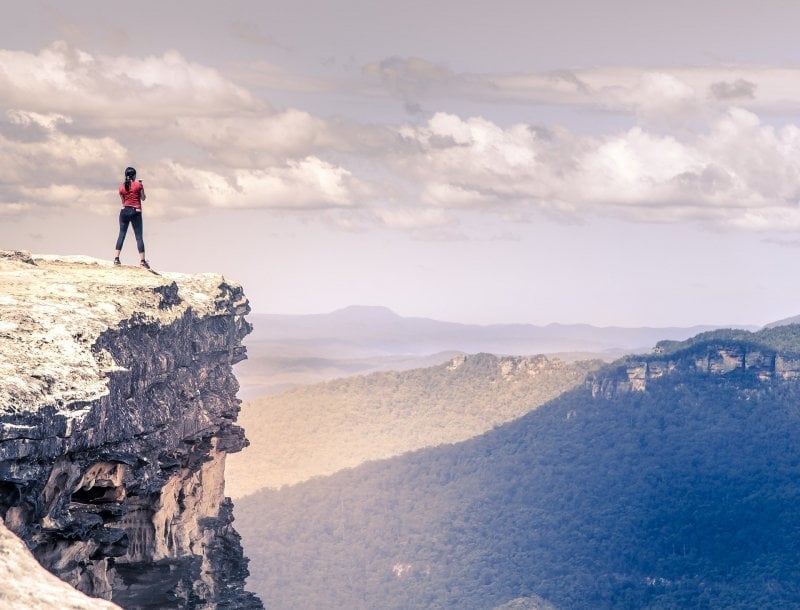
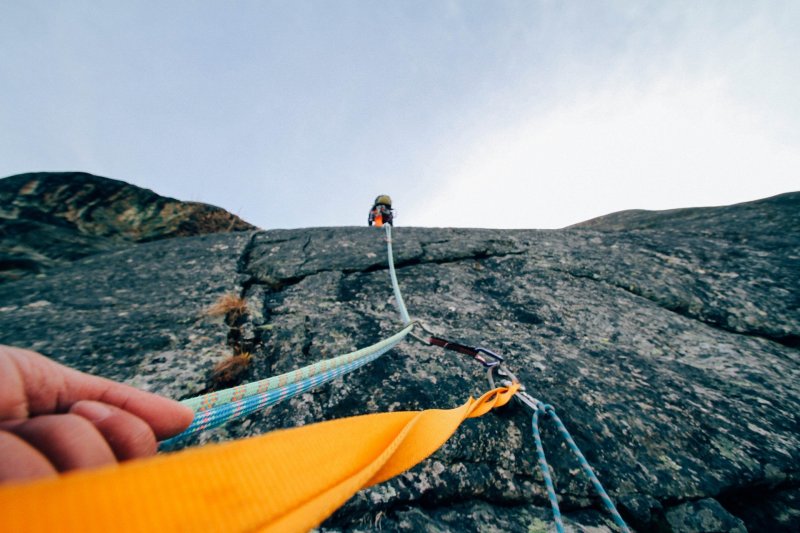
Pat and Miles take a breather on the hike in.
|
On the morning of February 2nd, 2002, Tom White, Miles Drake, Pat Bingham, Kim
and I all met up at Thorn Spring Campground. There we were joined by Jason
Bowers, whom I'd met a month earlier and learned was interested in caving. Our
destination would be a new (to us anyway) cave in the hills south of Franklin,
shown to us by
Jason's father Nathan.
Miles leads across some steep terrain.
|
After checking the topo maps we realized our trip to the cave would be a rather
long hike of up to two miles. We'd left our vehicles by the road and started
hiking up into the hills when we made a route decision that would
ultimately take us up and over a rather high ridge. The rest stops were
frequent but the views were great. At one point we found ourselves billygoating
along some very steep slopes at very high elevations.
Surprise-surprise!
|
When finally we did reach our destination and Miles seemed duely impressed
with the size of the entrance we'd led him to. The cave's entrance is about six
feet wide and four feet high. After folks had revived from the long walk, the
team suited up and dove in to explore the cave. I jumped in just
ahead over everyone else and snapped a few photos as they entered.
Jason and Miles slide into the leafy entrance room.
|
The entrance chamber of the cave slopes down at about a 30 degree angle. At the
lower end of the room, thirty feet in from the entrance, there's a 12
foot drop into a second chamber below. The walls of the entrance room are about
15 feet apart at the top of the drop and the ceiling is a bit over six
feet high. The floor is deeply covered in leaves that must have drifted in
after last
autumn. A few Cave Rat nests can be found on some of the ledges in the entrance
area.
Jason spots Tom as he down-climbs into the lower chamber.
|
Along the left hand wall, facing into the cave, there's a climbdown
of about 7 feet that bypasses the twelve foot drop into the chamber below. We
each took our turn working our way down the climb before proceeding into the
larger room below. As I approached the climb down the strata in the walls of
the cave finally came to my attention. The beds are rather thin and give the
walls a nice striated pattern.
|
From the second chamber it is possible to see back out the entrance. Dust on
the camera lens causes the light spots in the image.
|
The second chamber of the cave was much taller than the first, nearly 15 feet
high, and had a mud floor. The room's layout is roughly circular and there is a
waterline about three feet off the floor. As soon as I saw it I knew it didn't
spell good things for the potential of this cave. The floor, upon closer
examination, was a mat of mud and vegitative detritus that had apparently
washed in over the years. It seems enough had washed in that the most obvious
lead out of the room, a crawl at floor level, had choked with debris after just
a few short feet.
Miles emerges from checking a high crevice for potential to lead onward.
|
The team walked all about the walls of the chamber, at most 20 feet apart, and
searched for other ways out of the room. Besides the two routes back to the
entrance, and the choked lead at the floor, there was only one other lead with
any chance of going farther. This was a narrow crevace in the wall that headed
in the right direction, down strike, but didn't seem to move any air. Miles
climbed into the crevice, pushed a few feet in, and then withdrew after
finding no passage onward.
Miles describes the lead he just checked in the wall of the second chamber.
|
After his return Miles described the passage beyond the crevice squeeze, it
didn't sound hopeful. In fact his depiction made it sound as if, short of
excavating the mud from the floor, the cave was done. We lingered a bit longer
and then began our exit, climbing back up to the entrance and sun shine above.
Fanning out across the limestone, Miles and Pat look for new openings in the
ground.
|
We headed back to the vehicles via a different route than our earlier approach
to the cave. This took us across the limestone exposure in which the cave was
developed. We hoped to find another entrance somewhere further down the
limestone, that might lead in to the cave that must surely lie below. All this
to no avail, however. We eventually ran out of limestone and found ourselves in
a picturesque, yet entirely sandstone ravine. At least it made the hike back to
the cars more enjoyable.
Miles and Kim in an entirely non-cave bearing ravine.
|
|